

Pronouns and the Commands
There are only two places we can put object pronouns. We are familiar with these 2 options when dealing with regular conjugated verbs and infinitives / present participles.
- Pronouns are placed directly before a conjugated
verb
- Yo los compro "I buy them"
- Ella la escribió "She wrote it"
- Los comimos ayer. "We ate them yesterday"
- or they are attached to an infinitive or gerund
- Yo estoy comprándolos ahorita "I'm buying them right now."
- or Yo voy a mandarlas más tarde. "I'm going to send them later."
Command forms are similar in that
- Pronouns are attached to affirmative commands in the same way they attach to present participles and infinitives/
- Pronouns are placed directly before negative command form (which are actually Subjunctive conjugations) just like regular conjugated verbs.
Let's begin with a look at Direct and Indirect Object Pronouns with an affirmative Informal (Tú) Command.
I'll tell my dog Fifi to bring in the newspaper: 
- Fifi, Bring it!
- First we form an informal command out of our verb, Traer.
- To turn this into an affirmative command, we take the third person singular form (or the tú form, dropping the "s") : Trae.
- We now identify our direct object (DO) - the newspaper, el periódico. It is masculine and singular, so our pronoun is lo.
- We attach lo directly onto trae to form our informal command to Fifi:
- Fifi, ¡Tráelo!
Notice that we need an accent mark to preserve the original pronunciation of trae.
What if we want to tell Fifi not to bring the boot? With the Informal negative commands we need to use the subjunctive form.
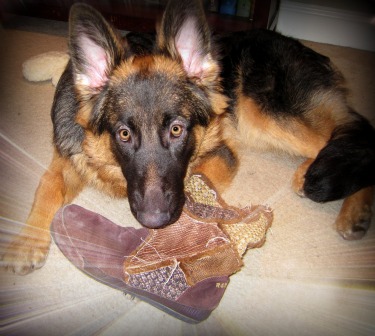
- First we take the same verb, Traer , and identify the first person singular (Yo ) form: Traigo
- Now we remove the"o" which leaves us with traig -
- And we add the opposite ending "as" to = Traigas.
- Now, we take our direct object pronoun and place it directly before the command after the No:
And we tell Fifi: ¡No la traigas!
Let's do another:
| Manolo compra las papas. | Manolo las compra. |
| ----------verb ----DO | ---------DO verb |
| Manolo buys -----the potatoes. | Manolo buys them. |
Now let's tell Manolo, "Buy them!"
- We use the Informal command form of Comprar: compra
- We add the Direct Object (DO) pronoun: las
- To end up with our command to Manolo, ¡Cómpralas!
Don't forget to add the accent to retain the original pronunciation of compra
Let's tell him not to buy the potatoes: Manolo, don't buy them!
- We still use Comprar, but for the Informal Negative command, we start with the Yo form, compro
- We take off the "o" and add the opposite ending "es"
- To get our negative command: No compres
- Now we add the Direct Object pronoun "las"
- And we place them directly in front of the command: Manolo, ¡No las compres!
Remember the word "no" in Spanish commands corresponds
with our "don't" in English.
| ¡No lo hagas! | Don't do it! |
| ¡No me digas eso! | Don't tell me that! |
| ¡Muéstramelo! | Show it to me! |
| ¡Suéltalo ahora mismo! | Drop it now! |
Double Object Pronouns work the same way with the Formal Commands.
As before, the Indirect always precedes the Direct Object Pronoun (I-D) and the Indirect object pronouns Le and Les convert to Se if followed by a Direct Object Pronoun:
| Pedro le va a traer el menú a Susana. -------IO verb------ DO------- IO specifier |
Pedro se lo va a traer. -------IO DO verb |
Let's look at an example using a Formal command (the object pronouns follow the identical I-D pattern as with the Informal Tú commands.)
To turn the sentence above into a Formal command, we first change Trae to its Formal command form:
- Identify the Yo form: Traigo
- Remove the "o" and add the opposite ending "a" = Traiga.
- Now, we add the object pronouns= Traiga + se + lo = ¡Tráigaselo!
| Él nos compra las papas a nosotros. ----IO verb ----DO ---------IO specifier |
Él nos las compra. ----IO DO verb |
- We make our command out of the verb: Compro - "o" = compr + opposite ending "e" = compre.
- Add the Object Pronouns: Compre + noslas = ¡Cómprenoslas!
- Don't forget to add the accent to retain the original pronunciation of compre
Negative Commands and the Pronouns
When commands (Formal or Informal) are in the negative, we must "unwrap" the Object pronouns.
Let's use this example of a Formal command:
| Sr. García, ¡cómprelas! | Sr. García, buy them! |
Now we want to tell Sr. García NOT to buy them.
We simply start with No ("do not") and peel off the Object pronoun and place it after the No and before the command:
| ¡No las compre! | Don't buy them! |
We no longer need to place an accent on the
command itself when there are no pronouns attached.
| Tráigala | No la traiga |
| Póngalo en la mesa | No lo ponga en la mesa |
| Córtelas | No las corte |
When there are Double object pronouns, we always put the Indirect object pronoun before the Direct Object pronoun.
This applies whether the pronouns are attached to an affirmative command or come before a negative command.
| ¡Sírvanoslo! | ¡No nos lo sirva! |
| ¡Cómpremelas! | ¡No me las compre! |
| ¡Tráigaselas! | ¡No se las traiga! |